Complex Numbers
A complex number consists of real and imaginary numbers in the form of a+bi in a Cartesian form, where a is the real part and b is the imaginary part and ‘i’ represents the unit imaginary numbers which is equivalent to the positive square root of -1.
Forms
Cartesian Form
a+bi
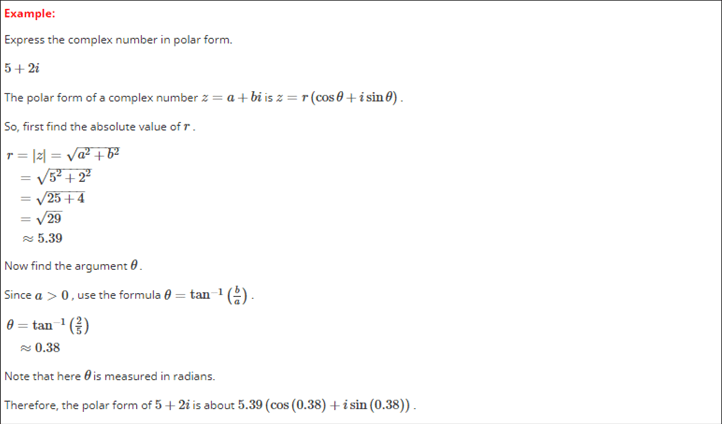
Polar form
- r (cosθ + isinθ)
- r cisθ (cis function)
Euler’s formula
- r eiθ
Note: i2 = -1 as square root of -1 squared is -1.
Real life applications
Electricity
Usually denoted by the symbol i, imaginary numbers are denoted by the symbol j in electronics (because i already denotes “current”). Imaginary numbers are particularly applicable in electricity, specifically alternating current (AC) electronics. AC electricity changes between positive and negative in a sine wave. Combining AC currents can be very difficult because they may not match properly on the waves. Using imaginary currents and real numbers helps those working with AC electricity do the calculations and avoid electrocution.
quadratic equations
In quadratic planes, imaginary numbers show up in equations that don’t touch the x axis. Imaginary numbers become particularly useful in advanced calculus.
signal processing
It is useful in cellular technology and wireless technologies, as well as radar and even biology (brain waves). Essentially, if what is being measured relies on a sine or cosine wave, the imaginary number is used.
ib’s learners profile
knowledgeable
I develop and use conceptual understanding, exploring knowledge across different kinds of problems encountered. I engage with issues and ideas to difficult questions about complex numbers.
thinkers
I use creative and critical thinking to solve complex problems. I exercise initiative in encountering problems that contains an element of surprise.
reflective
I thoughtfully consider the way each questions are done properly, other ways to solve it and my experiences. I work to understand my strengths and weaknesses in order to support my learning and personal development.

 Winston's Blog
This blog is simple yet informative. I now see the basic idea of complex numbers and its different forms. By giving the real-life application of this topic, I definitely can understand how complex numbers affects our lives. I am looking forward to read more blogs from you. And this would be helpful to future IB Learners for them to see how they are supposed to reflect for the IB Learner’s Profile by making an eJournal.
LikeLike
Wow, I’ve never learnt about complex or imaginary numbers before, especially their real- life uses. But it truly is an interesting topic, especially when u denoted different variables using the formulas, but I’m really surprised that even something such as ACs use numbers and sine waves to program, truly an eye-opener.Great post!
LikeLike
Complex and imaginary numbers are very new for me. Even though it is new, you have briefly explained what it is and is very easy to understand as you showed it with formulas and many great examples. It’s very interesting that things in our every day use such as ACs and electricity use imaginary numbers and sine waves to program. Such an amazing and interesting blog to read!
LikeLike